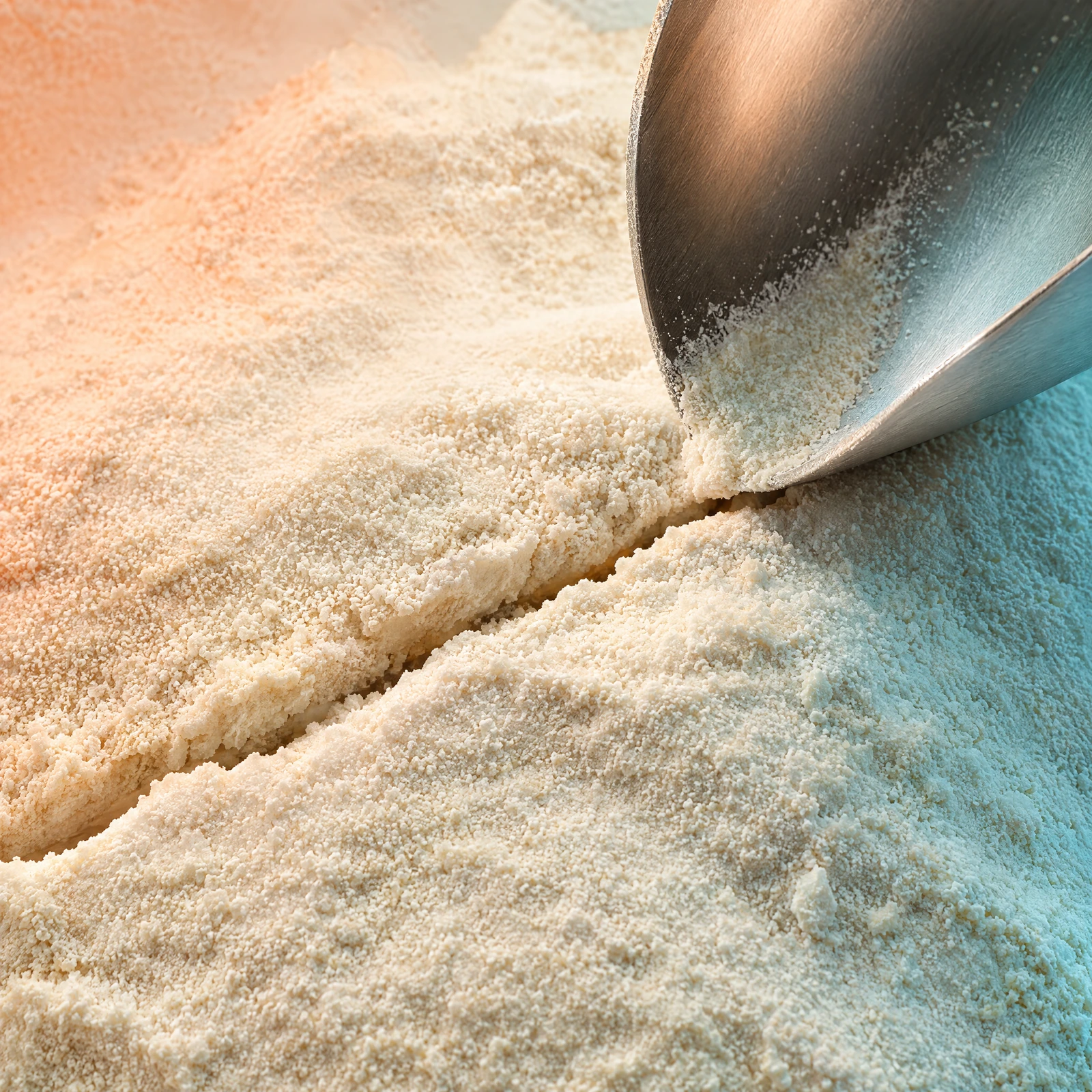
The European whey protein market is undergoing one of the most intense disruptions seen in recent years, with WPC80 and WPI becoming increasingly difficult to secure as global demand continues to rise.
WPC80
€21–23/kg
WPI
€25–27/kg
Market status
Hard to find
The European whey protein market is currently undergoing one of the most intense periods of disruption seen in recent years. Prices for high-grade dairy proteins have surged to historic levels, while availability has tightened to the point where many buyers describe the situation simply as hard to find.
In today’s market, WPC80 is trading around €21–23/kg, while WPI has reached €25–27/kg raw, depending on volume and contract structure. Yet, for many manufacturers and brands, price is no longer the main concern. The real challenge is securing consistent supply.
What is unfolding is not a short-term spike, but a structural imbalance that is reshaping the whey protein industry across Europe — and increasingly, globally.
A Market Where Availability Matters More Than Price
Across Europe, producers of WPC80 are operating under extreme pressure. Most large manufacturers are already sold out months in advance, with production volumes allocated primarily to long-term partners. Spot availability has nearly disappeared.
Buyers entering the market today are facing a completely different reality compared to just 18–24 months ago. Back then, whey protein was a relatively accessible commodity, with negotiable pricing and flexible sourcing options. Today, it has become a controlled resource.
In many cases, even when buyers are willing to accept higher prices, suppliers are unable — or unwilling — to offer additional volume. Allocation has replaced negotiation, and long-term relationships now determine access.
WPC80 at the Center of the Crisis
The tightest segment of the market is clearly WPC80. While lower-protein whey derivatives remain more available, high-protein concentrates are under severe strain.
The reasons are both structural and strategic. Whey protein production is inherently tied to cheese manufacturing, which means output cannot be rapidly increased in response to demand. At the same time, European milk production has been under pressure due to rising costs, regulatory constraints, and reduced herd sizes in several key producing countries.
This has resulted in less raw material entering the system, just as demand for high-protein ingredients continues to grow. Producers, facing limited input, are prioritizing efficiency and profitability, focusing on tighter control over production streams and higher-margin contracts rather than open-market availability.
WPI Follows Closely Behind
Whey Protein Isolate, traditionally positioned as a premium alternative to concentrate, is now experiencing similar pressure.
Although availability remains slightly better than WPC80, demand has increased significantly as buyers attempt to substitute or secure higher-purity protein sources. This has pushed WPI prices into the €25–27/kg range, with further upward pressure expected if WPC80 shortages persist.
The relationship between the two products has become increasingly interconnected. As one tightens, the other follows, creating a cascading effect across the entire whey protein category.
Global Pressure Is Tightening the European Market
The situation in Europe cannot be understood in isolation. The United States is currently experiencing an equally severe — if not more aggressive — shortage of whey protein. American producers have largely committed their volumes well in advance, with many contracts extending deep into 2026. As a result, U.S. buyers have increasingly turned toward Europe to secure supply.
This shift has added a new layer of pressure on the European market. Export demand has intensified, reducing domestic availability and accelerating price increases. In effect, European whey is now part of a globally contested supply pool.
At the same time, demand from Asia — particularly China and India — has become a major factor in tightening global supply. China continues to expand its consumption of dairy proteins, while India’s fitness and functional nutrition sectors are growing rapidly. Together, these two markets are absorbing significant global volumes, further reducing availability in Europe.
A Structural Supply Constraint
The underlying issue remains unchanged: supply cannot scale at the same speed as demand.
Whey protein production depends on multiple upstream factors — milk production, cheese output, and processing capacity. Each of these is subject to long investment cycles and structural limitations.
In Europe, milk production is not expanding meaningfully. Environmental policies, cost pressures, and operational constraints are limiting growth at the farm level. At the same time, building new processing capacity requires years of investment and planning. This creates a rigid supply framework, unable to respond quickly to rising global demand.
From Commodity to Strategic Resource
Historically, whey protein was treated as a relatively stable commodity — widely available, price-sensitive, and easily sourced. That model no longer applies.
Today’s market reality: • Supply is controlled • Access is limited • Long-term contracts are essential
Impact Across the Industry
The consequences of this shift are already visible across the supplement and food industries.
Brands are facing increased cost pressure, forcing them to reconsider pricing strategies, product formulations, and sourcing models. In some cases, protein content is being adjusted, while in others, companies are exploring blends or alternative protein sources.
At the same time, working capital requirements are increasing. Higher raw material costs, combined with the need for forward purchasing, are putting additional pressure on cash flow.
Looking Ahead
There is little indication that the situation will ease in the short term.
While some investments in dairy processing capacity are underway, meaningful increases in supply are unlikely before late 2026 or beyond. Demand, on the other hand, remains strong across all major regions.
As a result, the market is expected to remain tight, with continued volatility in both pricing and availability.
Industry Solutions & Private Label Opportunities
In this new market environment, having the right partner is becoming just as important as securing raw materials.
At VitaminLabs, we work closely with brands and businesses worldwide to navigate these challenges through reliable sourcing strategies, flexible formulation solutions, private label production, and scalable manufacturing adapted to current market conditions.
Reliable sourcing strategies for whey proteins
Flexible formulation solutions (WPC, WPI, blends)
Private label production for powders, RTDs, and functional beverages
Scalable manufacturing adapted to current market conditions
Whether you are launching a new product or adapting an existing one, having access to the right expertise and supply chain can make the difference between delays and growth.
Contact VitaminLabs for Private Label Solutions
Conclusion
The whey protein market has entered a new phase — one defined by scarcity, global competition, and structural constraints. For companies operating in this space, the implications are clear: securing supply early, building strong supplier relationships, and adapting to higher cost structures are no longer optional. They are essential for staying competitive in a market that has fundamentally changed.